Options and the wash-sale rule, in four trades.
Each case is a trade in the demo household, so you can open the demo and find the same figures.
The four cases
A stock loss, then a call on the stock
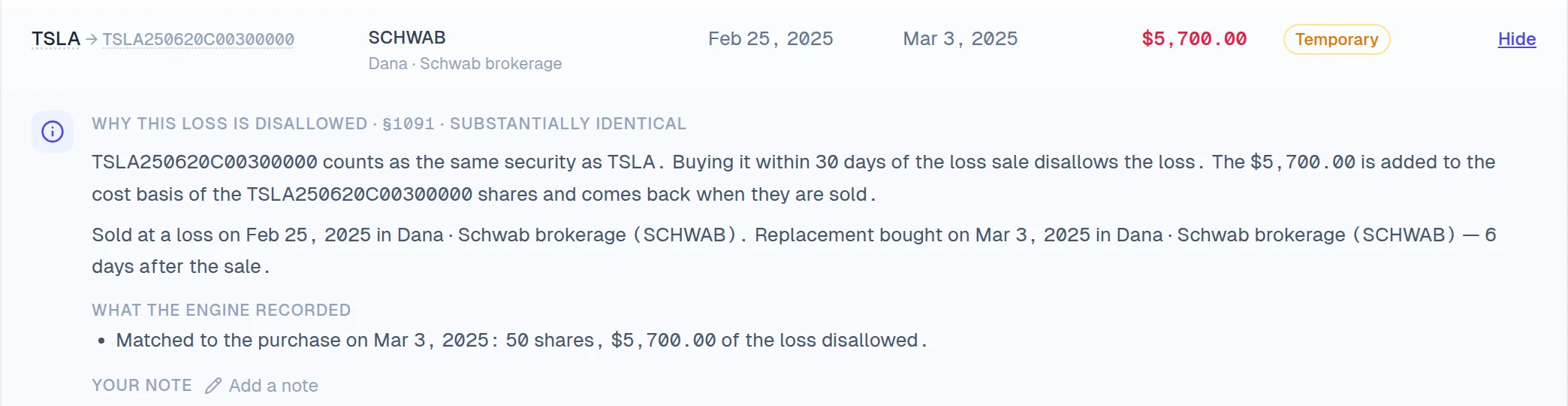
Under §1091(a), buying a call on the stock within the window is a wash sale. One contract is 100 shares' worth, so a single call can wash the whole loss on fewer shares.
Result · The $5,700 is disallowed and moves into the call, so its basis is $2,500 + $5,700 = $8,200. Selling the call is a $4,100 short-term loss. Brokers are not required to match stock to options. The demo's Schwab 1099-B shows no wash sale here.
In the demo: Wash Sales · TSLA, and the Form 8949 row for the call with code W on the stock row
| 2025-01-21 | Buy 50 TSLA at $404.00 (basis $20,200) |
| 2025-02-25 | Sell 50 TSLA at $290.00 (proceeds $14,500; loss $5,700) |
| 2025-03-03 | Buy 1 TSLA Jun 20 2025 300 call at $25.00 (premium $2,500) |
| 2025-05-12 | Sell the call at $41.00 (proceeds $4,100) |
A covered call that expires
The premium on an option you wrote is realised when it is bought back, expires or is assigned, as a short-term gain or loss (§1234(b)). Writing an option is not a purchase, so it never washes a loss.
Result · A $310 short-term gain dated 15 August 2025, on Form 8949 with the stock's cost shown as $0 and no code. Nothing happens to the shares.
In the demo: Tax P&L · the AAPL call, and the Form 8949 Part I row
| 2025-06-02 | Sell to open 1 AAPL Aug 15 2025 240 call against 100 AAPL held (premium $310) |
| 2025-08-15 | The call expires worthless |
A cash-secured put that is assigned
When a put you wrote is assigned, the premium is not a separate gain. It reduces the basis of the shares you are put, and the put gets no Form 8949 row.
Result · 100 NVDA with a basis of $18,000 − $720 = $17,280 and a holding period that starts on the assignment date. The gain or loss comes when the shares are sold. A deep-in-the-money written put can instead count as acquiring the stock for §1091, which WashTax checks once it is closed.
In the demo: Positions · NVDA in the Schwab account, with the basis and the acquired date
| 2025-09-02 | Sell to open 1 NVDA Sep 19 2025 180 put (premium $720) |
| 2025-09-19 | Assigned: buy 100 NVDA at $180.00 |
An SPX option on Form 6781
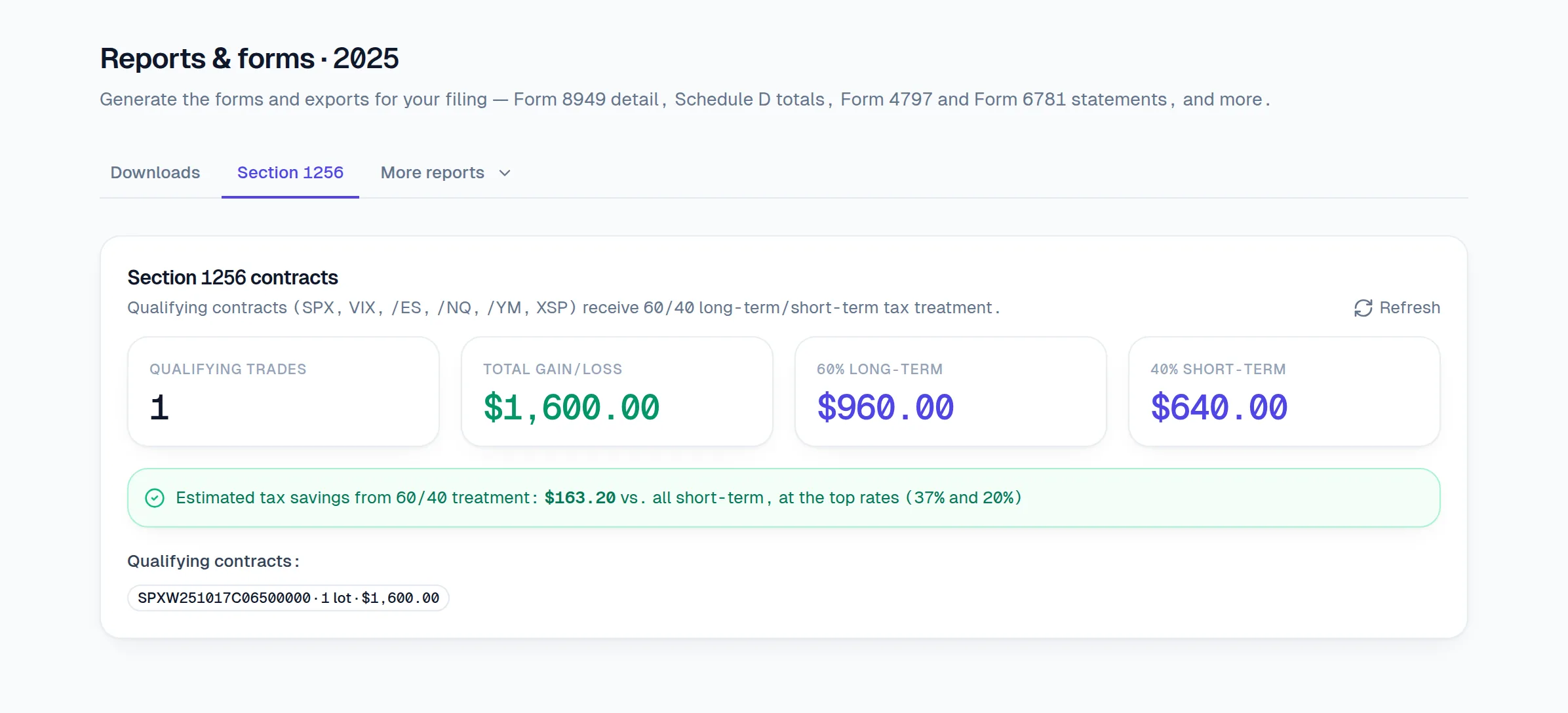
Broad-based index options are §1256 contracts. They are 60% long-term and 40% short-term whatever the holding period, marked to market at year end, and reported on Form 6781, not Form 8949. WashTax does not apply the wash-sale rule to them.
Result · A $1,600 gain on Form 6781, $960 long-term and $640 short-term. Options on ETFs such as SPY or QQQ are not §1256. They are ordinary equity options and stay on Form 8949.
In the demo: Forms · Form 6781, and the §1256 tab on the Planner
| 2025-09-08 | Buy 1 SPXW Oct 17 2025 6500 call at $42.00 ($4,200) |
| 2025-10-06 | Sell at $58.00 ($5,800) |
What else it handles
- ✓Option symbols are read in the OCC form and in the brokers' own, such as "AAPL 01/17/2025 C 150" and Fidelity's "-PYPL260206C55"
- ✓Written options are carried as short positions and never get code W
- ✓Options that expire are closed automatically on the expiry date, at $0
- ✓A policy setting decides how far matching between an option and its underlying reaches
- ✓Futures are §1256 contracts too, with no wash-sale matching, valued at their contract size (ES $50 a point)
What options traders ask
Does a bought put wash a stock loss?
What about rolling a losing option?
Straddles?
Year-end marks on open §1256 positions?
Import your option trades and see what each became
Every wash sale names its rule and shows both trades.